Home / Mechanical Engineering / Miho Museum Bridge: A Model of the Load Path
Miho Museum Bridge: A Model of the Load Path
A scale model that shows how a 120 m hybrid bridge holds itself up, with color marking compression, tension, and the space frame.
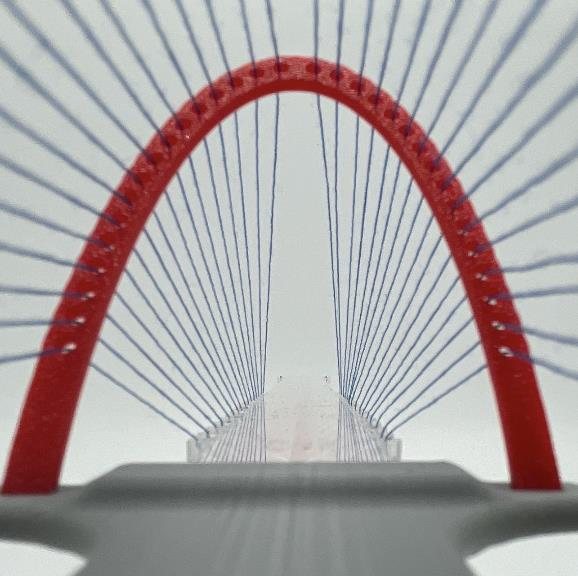
IDEA 210, Project 1: a detailed study of a structure of my choice, with a scaled 3D model that reflects its form, proportion, and load paths.
The bridge
The Miho Museum Bridge, designed by Leslie Robertson and Associates, is the approach to I.M. Pei's Miho Museum in Shiga, Japan. This hybrid extradosed-cantilever bridge spans a 120 m deep gorge with no intermediate supports, because the land below is sacred. It was designed to frame the approach to the museum while staying visually light in the landscape.
The model
My model focuses on how the bridge holds itself up and how its function and form become one thing. It expresses the bridge's visual lightness while exposing how the structure distributes its load.
The entrance, arch, and space frame are 3D printed. The stand and deck are laser-cut acrylic. The cables are strung by hand with sewing thread.
Reading the load path
Color carries the structure. The arch is red because it is in compression, and the cables are blue because they are in tension. The space frame is pink: it is mostly in compression, with some elements in tension.
Gallery
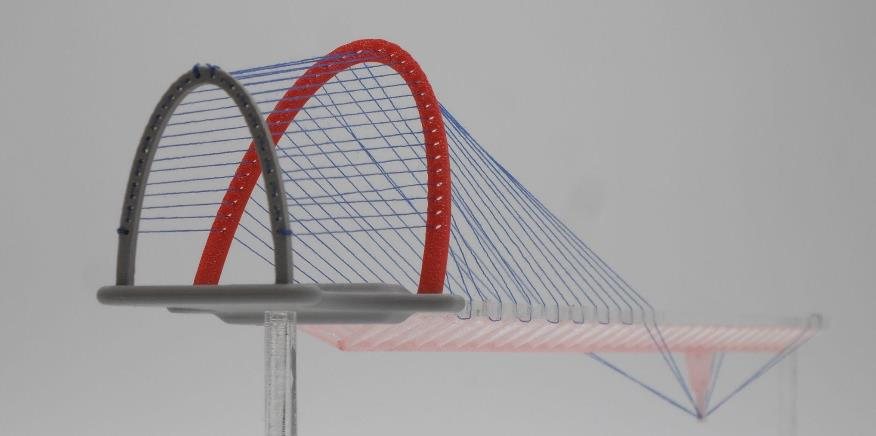
The model from the arch end
The 3D printed arch, with hand-strung cables sweeping down to the deck.