Home / Mechanical Engineering / Hopper Design Project (IDEA 170)
Hopper Design Project (IDEA 170)
A 9 gram, spiderweb-inspired mechanism built only from a supplied kit that hops for a set time before it releases.
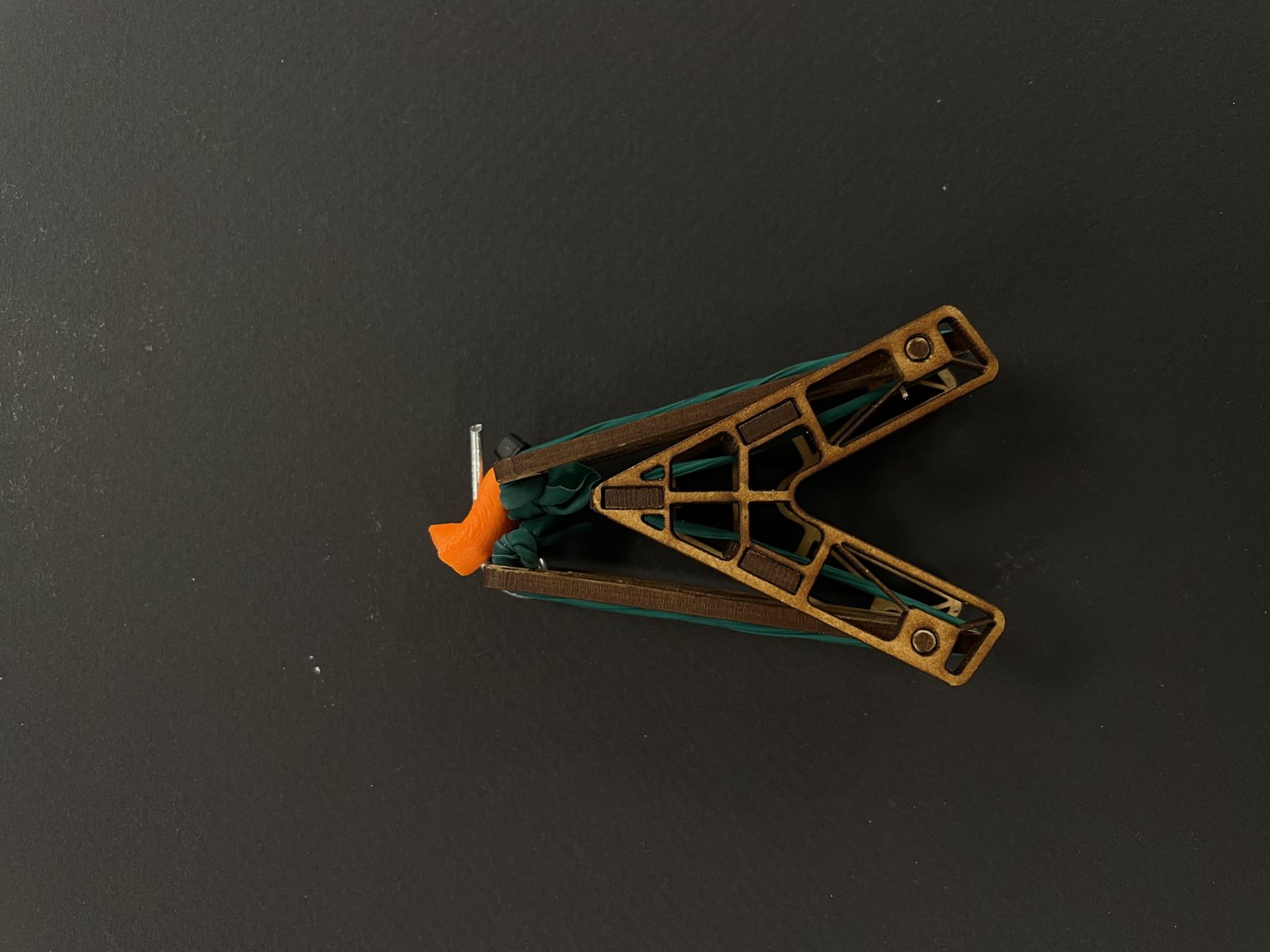
Fall 2023. The task was a biologically inspired mechanism that hops after waiting between eight seconds and a minute, built only from a predetermined kit, with design goals of my own.
I set myself the goal of making the whole frame from the kit's single aluminum plate, which pushed me toward a light, compact, space-efficient design.
Stage 1: getting off the ground
The first design was a triangular frame with two flaps that swing into the ground and push the hopper into the air. My first laser-cut prototype worked, but only jumped a couple of centimeters, so I moved to iterating.
Stage 2: component evolution
Every part went through many versions, laser cut in 1/8 in MDF and checked in SolidWorks assemblies.
- Connectors: I tested where material could come out, then added vertical as well as lateral braces after a cross-braced version collapsed under the band's force. The bracing pattern, inspired by spiderwebs and tensegrity, carries through the whole hopper.
- Frame: many more digital iterations than physical ones. I kept material at the interfaces, kept the outer frame thick, and hand-cut an aluminum version to gauge weight.
- Flaps: the most iterated part, because they had to be light to swing fast and strong enough to hit the ground at speed. They kept breaking at the same point, so I curved the cutouts to ease stress and added material where they failed. I also twisted the resistance bands during installation to stop them tearing.
Stage 3: how to wait
Controlled failure of MDF clips and deformed wire clips either stuck or released at once. The working timer pulls a wire through an earplug, creating friction-creep that slows the release. The wait changes with the length of the metal hook.
Results
- The finished hopper weighs 9 g, with a 7 g frame (SolidWorks estimates 6.56 g).
- The frame's volume is 10,212 mm³, which would fit in the 12,290 mm³ aluminum block.
- It reaches close to a meter and times correctly about 75% of the time.
- Stored energy was 0.598 J against 0.076 J of gravitational potential energy, an efficiency of 12.7%. Much of the flap motion happens after takeoff or is lost to impact, hinge friction, and the timer.
Gallery
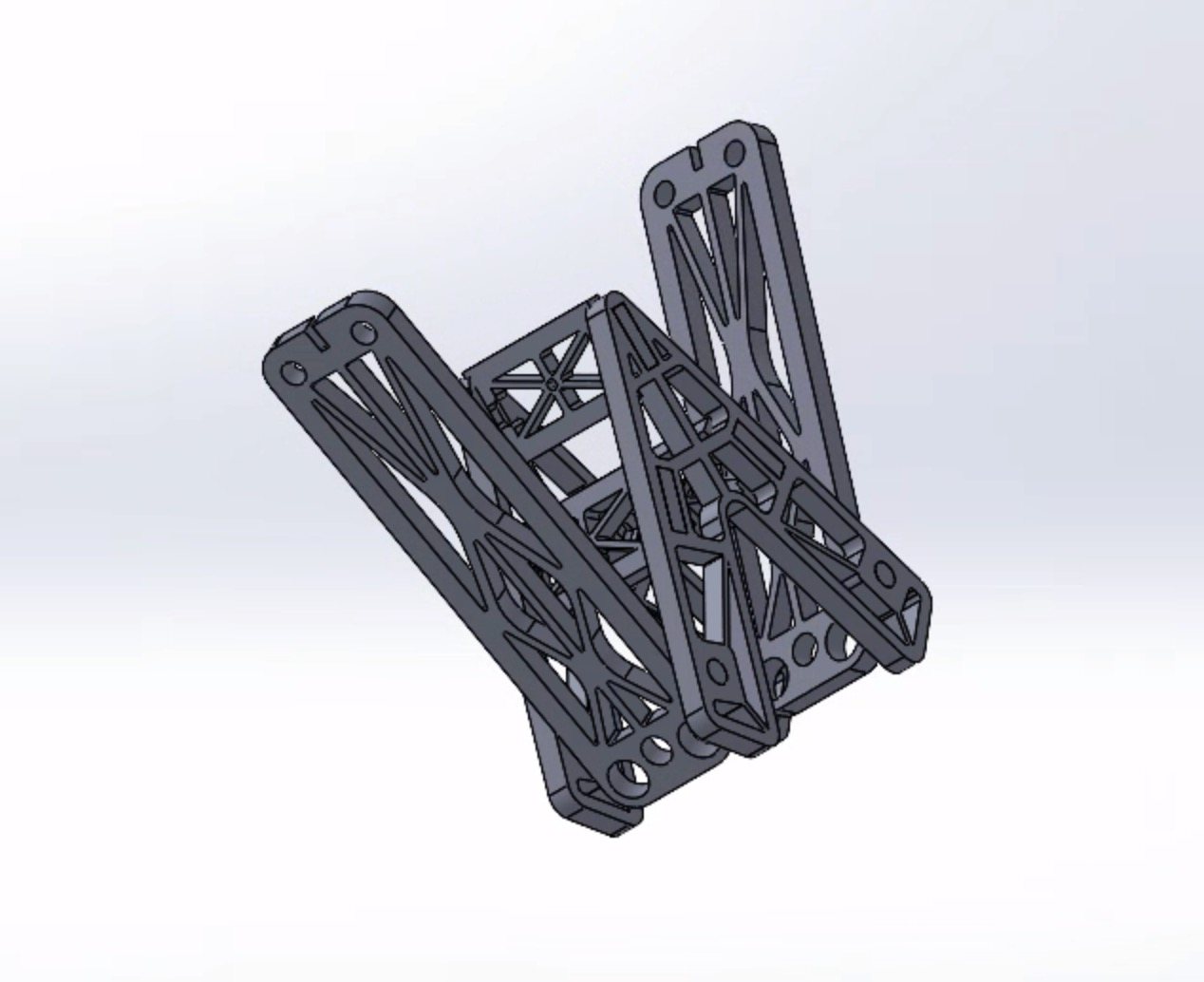
The final design in CAD
The cross-braced frame, connectors, and flaps modeled in SolidWorks.