Home / Mechanical Engineering / Recycled Wire-Gate Carabiner (IDEA 212)
Recycled Wire-Gate Carabiner (IDEA 212)
A carabiner built from the pen clips of empty Uni One pens, with a locking gate and a heat transfer analysis of the plastic weld that holds it together.
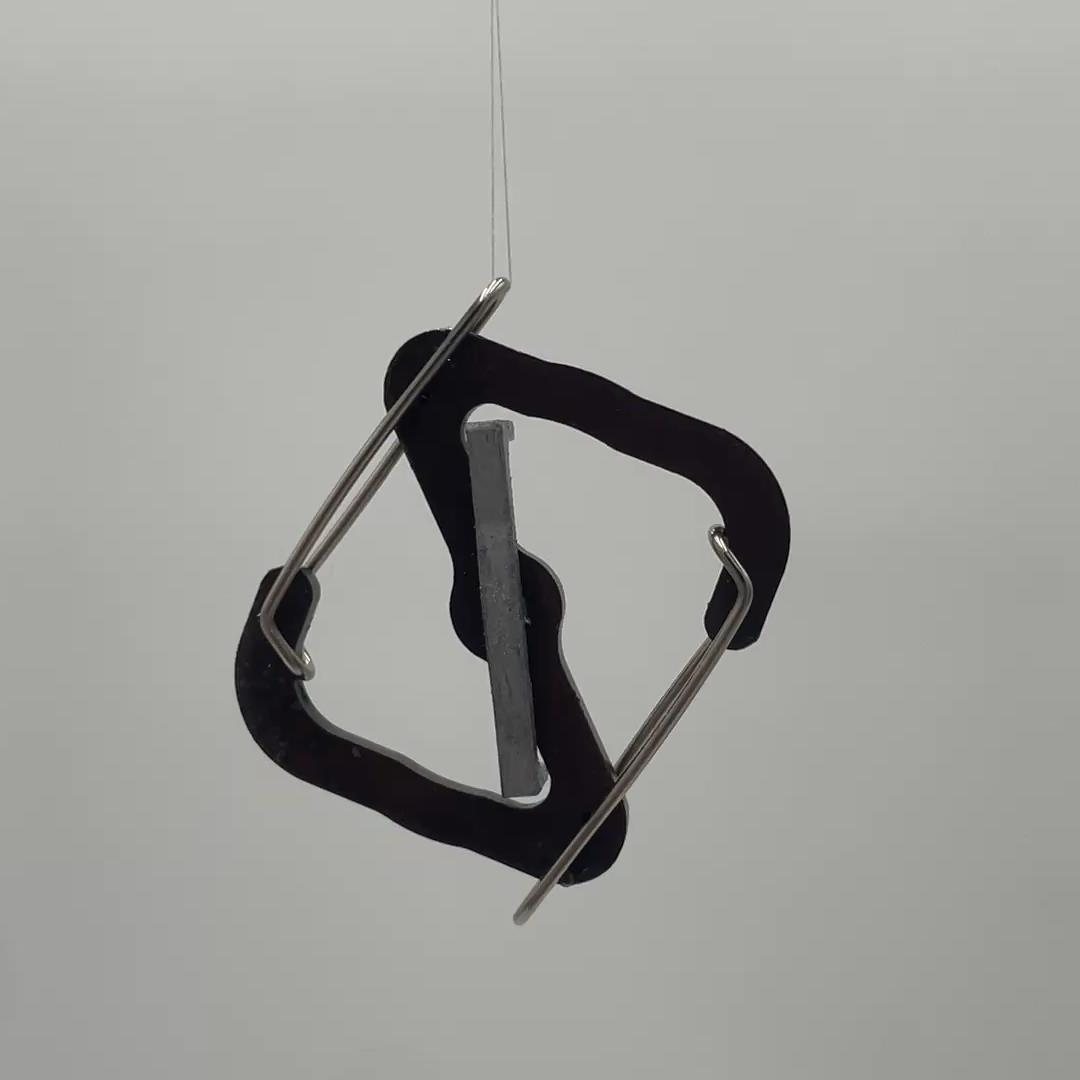
IDEA 212 asked for a metal object or mechanism made with two of the methods taught in class, plus a heat transfer problem tied to the project.
Starting point
I had a drawer of empty Uni One pens with wire-gate clips. Craighill had turned carabiner gates into pen clips, so I went the other way: could the pen clips become a carabiner?
Development
The body started as a simple Z shape with a hole so it could mount permanently on a keychain and be held in the manual mill. That hole turned into the pivot for a rotating lock, which made the part much more useful. When the lock is turned to the end of its path, neither clip can deflect.
Failures
The heat-blued gates have so little thermal mass that they kept annealing under the torch. Play in the manual mill also left the lock hole inconsistent and off-center.
Revision
I electroplated the body in copper. The coating was thin and wore quickly, so I sealed it with polyurethane. For the lock, I turned a rivet setter from an M8 bolt on the lathe and plastic welded the PETG lock to the body.
Heat transfer
I modeled the rivet setter cooling from a 300 °C hot plate with a lumped capacitance model, then checked the Biot number. At a convection coefficient of 100 W/m²K the model holds. When I quenched the setter in water, the Biot number rose to 0.27 and the lumped model no longer applied. The analysis puts the rivet setting time at about 15 seconds.
Gallery

Initial CAD Mockup
The body started as a plain Z shape. The dimensions were constrained by the dimensions of the wire gate pen clips I was using. The hole began as a way to mount it on a keychain and hold it in the mill, then became the pivot for the rotating lock.